
Our Story
TRINITY'S MISSION
At Trinity Episcopal Church, we seek to be a true home away from home. Rooted in the Anglican tradition, we welcome Austin Peay students, young families, military neighbors, and every person who walks through our red doors. Here you will find meaningful worship, spiritual growth, and a diverse community where you belong and can serve. To seek and serve God in Christ is our mission — to God be the glory.
HISTORY OF TRINITY PARISH
Trinity’s story begins with an act of neighborly generosity. In 1832, when Clarksville’s small band of Episcopalians set out to build a church, it was the town’s Presbyterians who helped them raise it — convinced their city would be better with both. That makes Trinity one of the five oldest Episcopal parishes in Tennessee, and a church built on welcome from its very first day.
When the Civil War reached Clarksville and Union forces occupied the town, nearly everything closed. Trinity’s doors stayed open — one of the few in the city allowed to remain so. Our rector, the Rev. Samuel Ringgold, held that “decent and orderly” worship mattered for every soul, regardless of politics or war. Even in those hard years Trinity looked outward, planting rural mission churches — one of which still worships to this day.
That instinct to serve never left. In 1983, three Trinity women started a modest Wednesday soup kitchen in the Parish Hall — three guests came the first week. It grew into Loaves & Fishes, a ministry of five downtown churches serving tens of thousands of meals a year from Trinity’s kitchen, honored with a Presidential Citation for Volunteer Service. It still feeds Clarksville six days a week — and Trinity volunteers still serve there — to this day.
Those same decades brought overdue firsts: in 1982, Elinor “Tootsie” Martin became Trinity’s first woman Senior Warden, and in the years that followed, Sallie Goodrich became the first African American member elected to the Vestry by the parish.
There were quieter tests of welcome, too. In 1991, when Austin Peay’s Gay and Lesbian Alliance asked to use the Parish Hall for a dinner, the Vestry opened the doors. The vote was not unanimous — and we tell that part of the story too, because welcome at Trinity has never been an accident. It has been a choice, made again and again.
The church you see on Franklin Street today rose in 1877, its Romanesque arches replacing the original building, joined in time by the rectory and the parish house — and listed today on the National Register of Historic Places, where it has stood since 1982. Generations have cared for these walls with remarkable faithfulness.
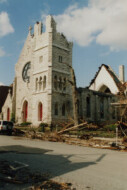
Then, in January 1999, a tornado tore through downtown Clarksville and destroyed a quarter of its buildings. It lifted Trinity’s roof and dropped it into the sanctuary. Years earlier, at a vestryman’s quiet urging, the parish had upgraded its insurance to a full-restoration policy — a faithful decision no one knew they would need. What the storm could not touch was the congregation. The people of Trinity rebuilt it all — walls, windows, pews — and crowned the restoration with a new pipe organ, whose music once again fills the nave every Sunday.
Not every chapter of a 190-year story is easy to tell. Trinity’s past also touches the era of slavery — a chapter we face honestly rather than hide, because a church built on welcome owes its neighbors the whole truth. You can hear that story, told among the grave stones, in the video tour below.
Step inside and the story keeps telling itself — in light. Trinity’s stained glass windows are among the most beautiful in the city, given across the generations in memory of the saints of this parish, each one telling a piece of the story of faith.
Look for the Good Shepherd window in the nave — Jesus cradling a lamb in warm, golden glass, a window that seems to hold the whole room in its calm. 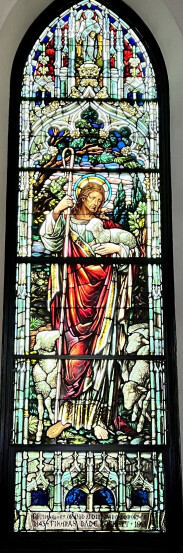

Then find the Ascension window above the chancel: Christ rising amid a host of angels, every color blazing on a bright morning.
Nearly two hundred years on, this story is still being written — and the next chapter could include you. Explore the videos below on Trinity’s history and architecture, or better yet, come stand in the light of those windows yourself some Sunday morning. The red doors are open.